Monero Transaction Fees: What XMR Transfers Cost in 2026
Monero transaction fees are low: the median XMR transfer cost 0.0000445 XMR, about $0.027, in a sample of 5,387 transactions we measured on 27 October 2026. Over the previous 30 days, blocks arrived every 119.8 seconds on average, so the 10 confirmations most wallets and exchanges wait for took about 20 minutes.
Every number on this page comes from the Monero blockchain itself, read from a public node, plus a USD price from CoinGecko. Nothing is estimated from a fee calculator. The full dataset and the script are free to download and reuse.
Monero transaction fees at a glance
- Median fee per transaction: 0.0000445 XMR ($0.027)
- Average fee per transaction over 30 days: 0.000247 XMR ($0.139)
- Typical transaction size: 1,538 bytes
- Average time between blocks: 119.8 seconds
- Time to 10 confirmations: about 20 minutes
- Transactions in 30 days: 848,562, or 28,285 a day
Last updated: 27 October 2026, 05:47 UTC. XMR price at measurement: $600.83.
Monero transaction fees right now
We pulled the last 200 blocks (blocks 3,792,868 to 3,793,067) and read the fee of every transaction inside them. That gave 5,387 real transactions.
| Measure | XMR | USD |
|---|---|---|
| Median fee per transaction | 0.0000445 | $0.027 |
| 90th percentile fee | 0.000703 | $0.42 |
| Median fee per kilobyte | 0.00002 | $0.012 |
| Median transaction size | 1,538 bytes | |
Half of all Monero transfers in the sample paid less than three US cents. Nine in ten paid less than 42 cents.
Monero transaction fees vs Bitcoin, Ethereum and USDT
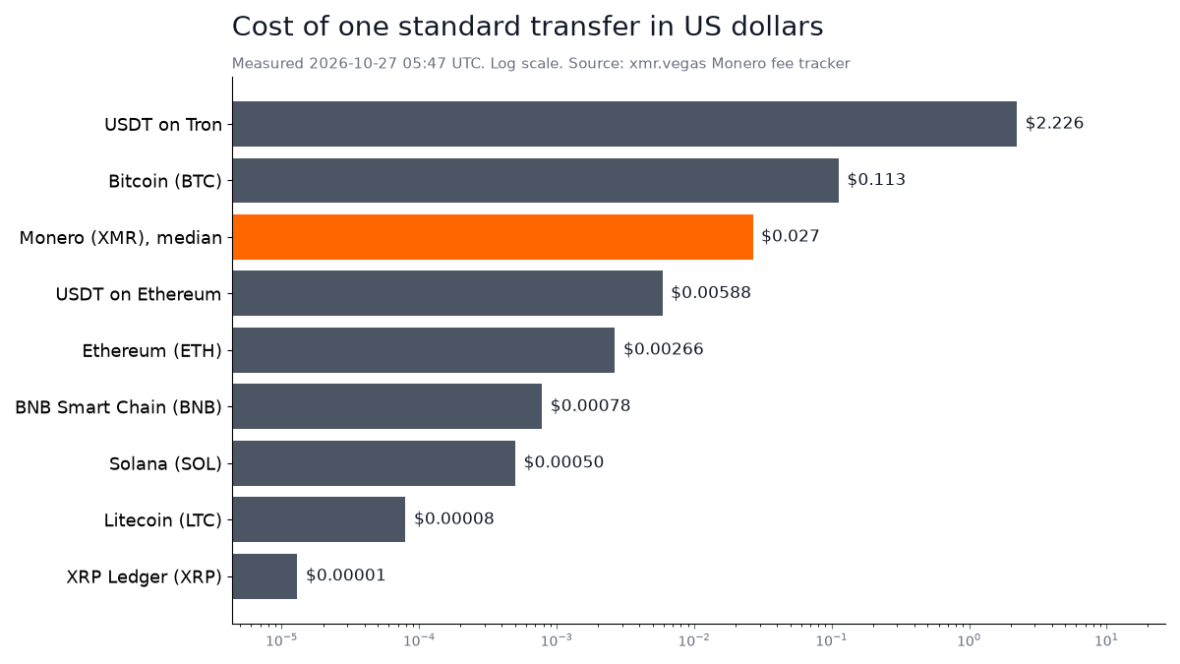
At the same moment, we measured what one standard transfer cost on eight other networks, using each network’s own public fee data. Monero’s median fee was about 4 times cheaper than a Bitcoin payment aimed at the next block, and about 83 times cheaper than sending USDT on Tron from a wallet with no staked energy.
| Network and transfer | Fee (USD) |
|---|---|
| USDT on Tron (no staked energy) | $2.226 |
| Bitcoin payment, next block | $0.113 |
| Monero, median transaction | $0.027 |
| USDT on Ethereum | $0.0059 |
| ETH transfer on Ethereum | $0.0027 |
| BNB Smart Chain transfer | $0.0008 |
| Solana transfer | $0.0005 |
| Litecoin payment, next block | $0.00008 |
| XRP Ledger payment | $0.00001 |
Two things stand out. Ethereum gas was very low at the time of measurement, so a plain ETH transfer came in under Monero. And the networks below Monero in the table are not private: every Monero transaction hides the sender, receiver and amount, which makes it bigger in bytes. You pay a little more for that.
For a deeper look at the two coins side by side, see our guide on XMR vs BTC.
Monero fees over the last 30 days
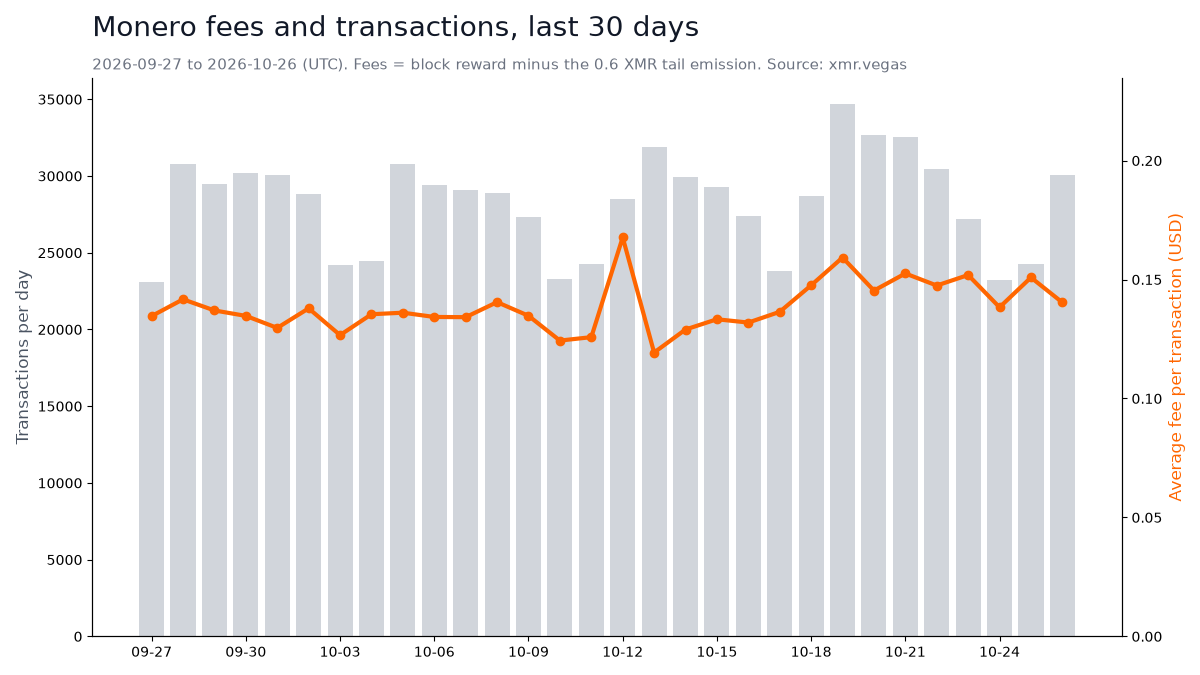
Between 27 September and 26 October 2026, the Monero network processed 848,562 transactions and paid miners 209.95 XMR in fees. Daily volume ranged from 23,063 transactions (27 September) to 34,667 (19 October).
| Week (UTC) | Transactions | Per day | Total fees (XMR) | Average fee (XMR) | Average fee (USD) |
|---|---|---|---|---|---|
| 27 Sep to 3 Oct | 196,590 | 28,084 | 48.63 | 0.000247 | $0.135 |
| 4 Oct to 10 Oct | 193,255 | 27,608 | 47.36 | 0.000245 | $0.134 |
| 11 Oct to 17 Oct | 195,018 | 27,860 | 48.51 | 0.000249 | $0.135 |
| 18 Oct to 24 Oct | 209,409 | 29,916 | 52.40 | 0.000250 | $0.149 |
| 25 Oct to 26 Oct | 54,290 | 27,145 | 13.05 | 0.000240 | $0.145 |
In XMR terms the average fee barely moved: between 0.000240 and 0.000250 XMR every week. The small rise in dollar terms during the week of 18 October came mostly from the XMR price, which ranged from $519 to $621 over the month.
Why the average Monero fee is higher than the median
The 30-day average ($0.139) is about five times the median ($0.027). That gap is normal. Monero charges by size, and a few large transactions pull the average up.
- More inputs, bigger transaction. A wallet that combines many small received amounts into one payment builds a much larger transaction, and pays for every extra byte.
- More outputs. Exchanges and pools paying many people in one transaction create big transfers with big fees.
- Priority setting. Wallets let you pay a higher fee multiple to get into the next block when blocks are full.
A simple payment from a normal wallet, with one or two inputs and two outputs, sits near the median. That is the number to use when you plan a single transfer.
How long a Monero transaction takes
Monero targets one block every two minutes. Over the last 30 days the real average was 119.8 seconds, with daily averages between 114.5 and 126.6 seconds.
- First confirmation: about 2 minutes on average.
- 10 confirmations: about 20 minutes. The Monero protocol locks newly received funds for 10 blocks before they can be spent again, so many exchanges and services credit deposits after 10 confirmations.
Some services ask for more confirmations than 10. Check the deposit page of the service you use for its own rule.
What sets the fee on a Monero transfer
Three things decide what you pay:
- Size in bytes. Ring signatures and range proofs hide who paid whom and how much. They also make each transaction larger than a Bitcoin or Litecoin payment.
- The network’s per-byte fee. Monero adjusts it to recent block sizes, so the base rate stays low while blocks have room.
- Your priority choice. Low or default priority is enough most of the time. Higher priority only helps when blocks are full.
Fees go to the miner who finds the block, on top of the fixed block reward. Since tail emission started at the end of May 2022, that reward is 0.6 XMR per block.
If you are comparing Monero with other privacy options, our guide to reasons people choose Monero covers the wider picture.
How we measured Monero transaction fees
- 30-day history: we read every block header from 27 September to 26 October 2026 (UTC) from a public Monero node. Since tail emission, a block’s reward is 0.6 XMR plus all fees in that block, so block fees equal the reward minus 0.6 XMR. We checked this against the summed fees of every transaction in two recent blocks: the numbers matched to the last digit.
- Current fees: per-transaction fees and sizes from the 200 most recent blocks.
- Prices: CoinGecko daily XMR/USD for the history, spot price for the snapshot, cross-checked against CoinPaprika ($599.79).
- Other networks: one live measurement per network at the same time, using each network’s own public data.
Fees change block to block. The comparison table is a single snapshot, not an average. The 30-day figures are full days only.
Download the data: daily Monero fees, 27 September to 26 October 2026 (CSV). Free to reuse under CC BY 4.0 with a link to this page.
Monero transaction fees FAQ
How much is a Monero transaction fee?
The median Monero transaction paid 0.0000445 XMR, about $0.027, in a sample of 5,387 transactions on 27 October 2026. Larger transactions with many inputs pay more, so the 30-day average was higher at about $0.139.
Is Monero cheaper to send than Bitcoin?
Yes, at the time of measurement. A median Monero transfer cost about $0.027, while a Bitcoin payment aimed at the next block cost about $0.113. Both change with network demand.
How long does a Monero transaction take?
The first confirmation takes about 2 minutes on average. Received funds are locked for 10 blocks, so a deposit usually becomes usable after about 20 minutes.
Why are Monero transactions bigger than Bitcoin transactions?
Monero hides the sender, receiver and amount with ring signatures, stealth addresses and range proofs. That extra cryptography makes a typical transaction about 1,538 bytes, which is why the fee per transaction is higher than on some public chains.
Do Monero fees go up when the price goes up?
The fee in XMR stayed almost flat over the last 30 days, between 0.000240 and 0.000250 XMR per transaction each week. The dollar cost moves with the XMR price.
Can I use this Monero fee data?
Yes. The daily dataset is free to download and reuse under CC BY 4.0. Please credit xmr.vegas and link to this page.
References
- Monero block data: public Monero node RPC (get_block_headers_range, get_block, get_transactions), read 27 October 2026.
- Monero Project, Moneropedia: tail emission.
- CoinGecko XMR/USD market data; CoinPaprika XMR/USD spot price.
- Other networks: mempool.space, litecoinspace.org, public RPCs for Ethereum, BNB Smart Chain, Solana, TronGrid and the XRP Ledger.